



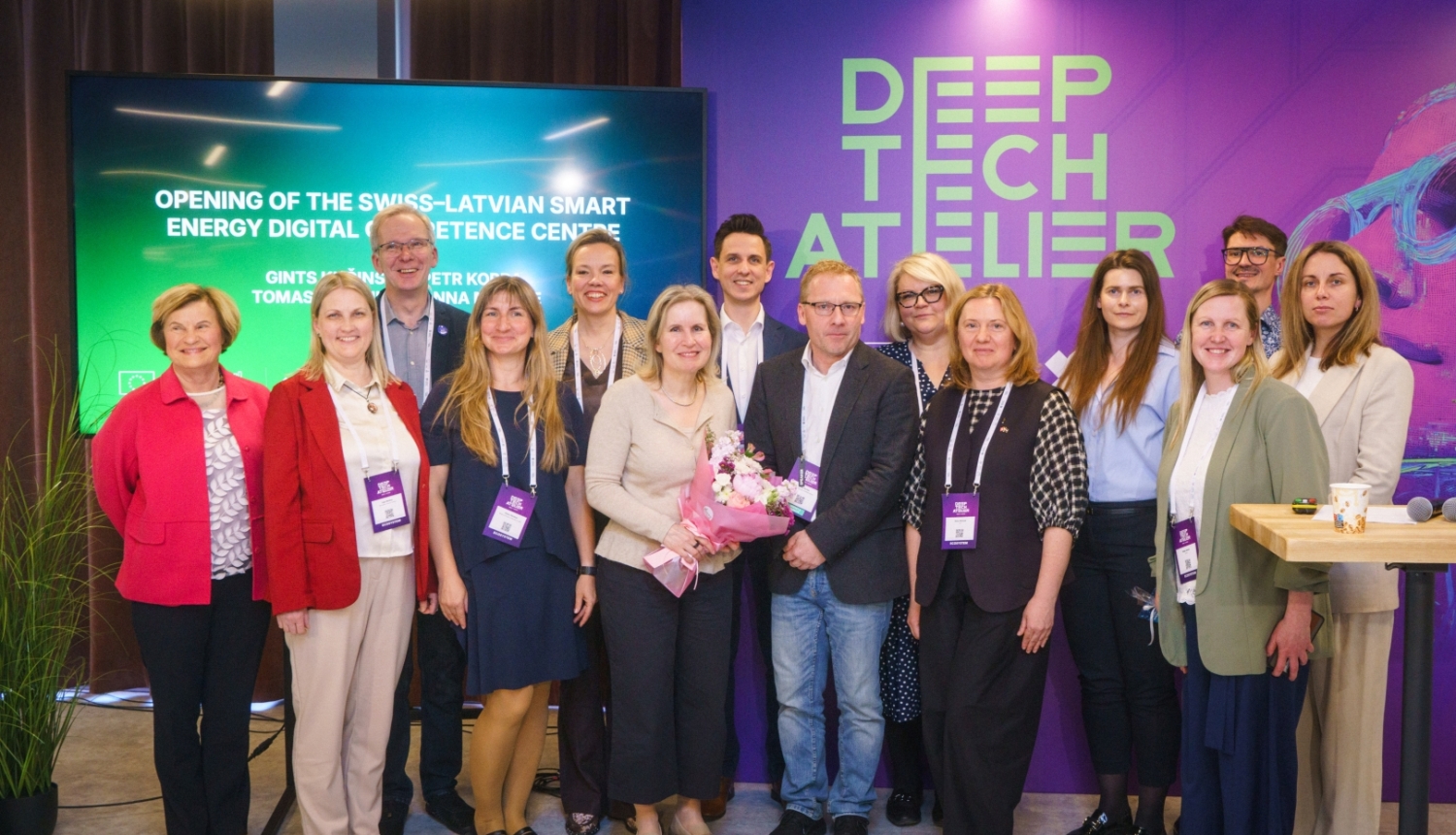
On May 15, the Swiss–Latvian Smart Energy Digital Centre was officially launched in Riga as part of the international conference Deep Tech Atelier 2026. The centre has been established within the framework of the LACISE project, led by the Institute of Solid State Physics, University of Latvia (ISSP UL), under the Swiss–Latvian Cooperation Programme “Partnership in Applied Research”.
The aim of the Centre is to strengthen long-term collaboration between research, innovation-driven companies, and industry in Latvia and Switzerland, while accelerating the development and real-world implementation of new technologies.
The opening event featured remarks by H.E. Anja Zobrist Rentenaar, Ambassador of the Swiss Confederation to Latvia, Lithuania and Estonia, as well as Gints Kučinskis, LACISE project coordinator and leading researcher at ISSP UL.
During the event, project partners presented their activities: Gints Kučinskis introduced research carried out at ISSP UL on battery longevity and hydrogen production technologies, Anna Mutule from the Institute of Electronics and Computer Science presented developments in smart grids and digitalisation, while Professor Petr Korba from the Zurich University of Applied Sciences (ZHAW) showcased AI-based solutions for power system stability analysis. An industry perspective was provided by Tomass Liepnieks, Head of Innovation Management at Sadales tīkls.
“Energy is currently undergoing significant transformation – the role of renewable energy sources is increasing, and energy storage is becoming ever more important. This means we need new solutions and new forms of collaboration,” said Gints Kučinskis.
The Swiss–Latvian Digital Centre will serve as a permanent collaboration platform, connecting scientific expertise with industry needs and facilitating the transfer of research results into practical applications. Its flexible, virtual format will enable continuous cooperation between researchers, companies, and innovation ecosystem stakeholders in both countries through thematic seminars, expert discussions, and partnership initiatives, ensuring the Centre’s long-term impact beyond the duration of the project.
Latvian scientists play an equal role in this international collaboration, emphasises ISSP UL Director Andris Anspoks:
“We work with international institutions as equal partners, not as students and teachers. Our goal is to ensure that this collaboration continues beyond the project, as modern science cannot develop in isolation – it is built on cooperation, specialisation, and mutual learning.”
Given the rapid transformation of the energy sector, the establishment of the Centre is particularly timely. The Digital Centre provides a practical contribution to strengthening Latvia’s innovation capacity and energy resilience, while deepening cooperation with Switzerland in a strategically important field.
About the LACISE Project
The LACISE project is supported by the Swiss Contribution, which aims to reduce economic and social disparities within the European Union. It is implemented under the Swiss–Latvian Cooperation Programme Partnership in Applied Research (Grant Agreement No. LZP/LV-CH-RESEARCH/PC2). The programme is administered by the Ministry of Education and Science and the Latvian Council of Science. The total programme funding amounts to EUR 12,352,941, of which 85% (EUR 10,500,000) is provided by the Swiss contribution and 15% (EUR 1,852,941) is co-financed by the Latvian state budget.
The LACISE project, focusing on ICT and smart energy, is implemented by the Institute of Solid State Physics, University of Latvia (Latvia), in cooperation with the Institute of Electronics and Computer Science (Latvia), Riga Technical University (Latvia), the Paul Scherrer Institute (Switzerland), the Zurich University of Applied Sciences (Switzerland), and the Swiss Center for Electronics and Microtechnology (Switzerland).