



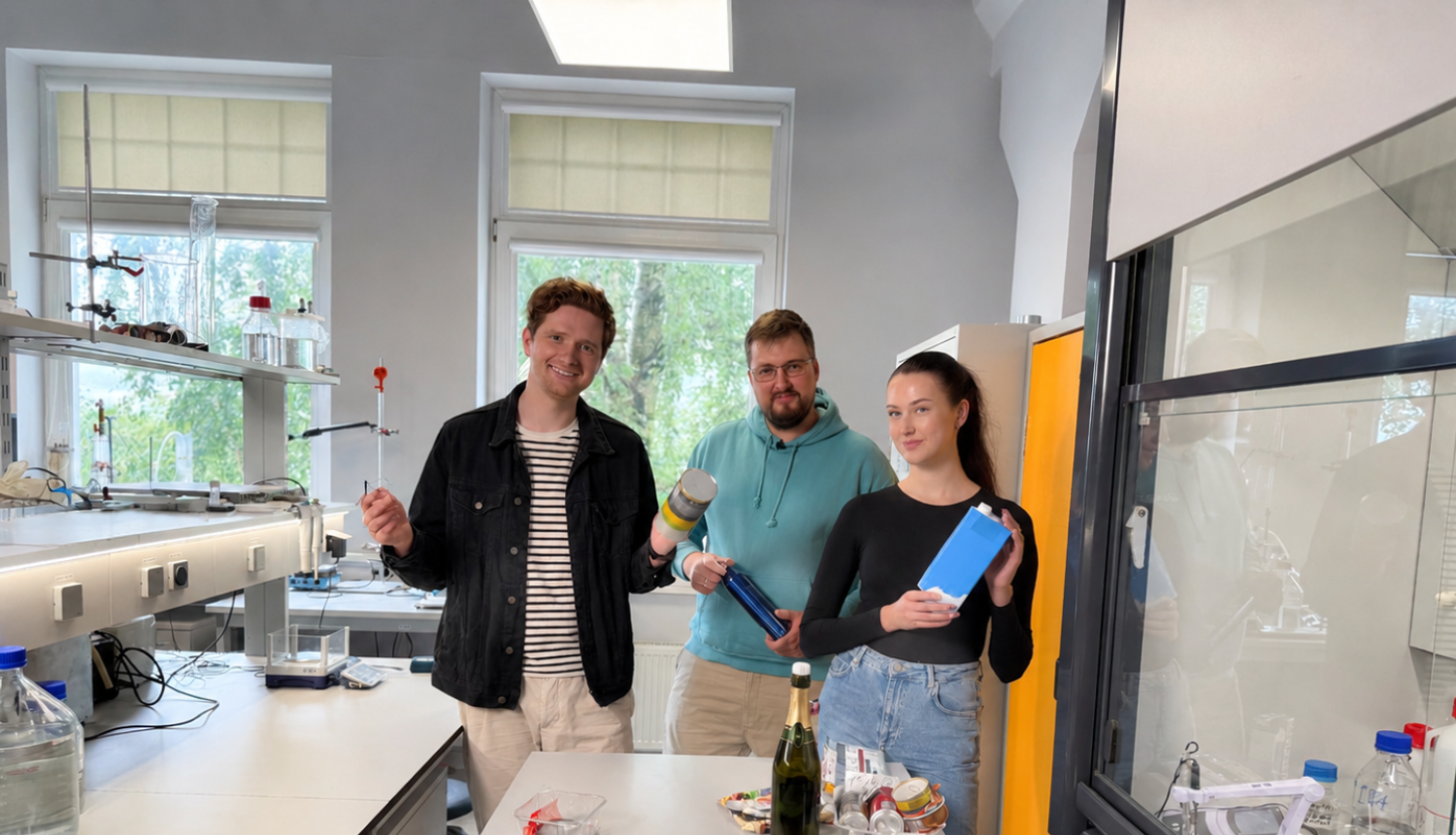
Is it possible to determine in 60 seconds which everyday waste contains aluminium? To find out, TV host Mārtiņš Spuris challenged digital content creator Undīne Ozoliņa, also known as Undixone, to a seemingly simple task – to sort various household waste into two groups: those containing aluminium and those not containing aluminium.
A water bottle, a milk carton, drink cans, foil and various other everyday packaging were placed on the table. But the task turned out to be more difficult than it seemed at first. Not everything that shines is aluminium, while even a very ordinary milk carton can have a very useful aluminium layer.
Researchers at the Institute of Solid State Physics of the University of Latvia explain that waste that we throw away in the trash without thinking about it can become a valuable research material for scientists. For example, aluminium-containing waste can be used to produce hydrogen – one kilogram of pure aluminium can theoretically produce enough hydrogen to fully charge about 30 medium-power laptops.
But it’s not enough that the object contains aluminium. Before the experiment, the material must be sorted and prepared accordingly – crushed, cleaned or separated from other coatings. The results are influenced by both the purity and alloy of the aluminium, as well as the colour, plastics and other impurities.
The research can be done with a wide variety of aluminium waste, such as drink cans, foil, old window frames, wires, medicine packaging, production waste, laminated materials, etc.
Would you recognize aluminum better than Undixone? Perhaps a whole world useful to science is hiding in your waste bin!?